

What happens when you take an EV into Die Hel on South Africa's worst road?
The road into Gamkaskloof is only 37 kilometres, but takes more than two hours to drive
- Justus Visagie

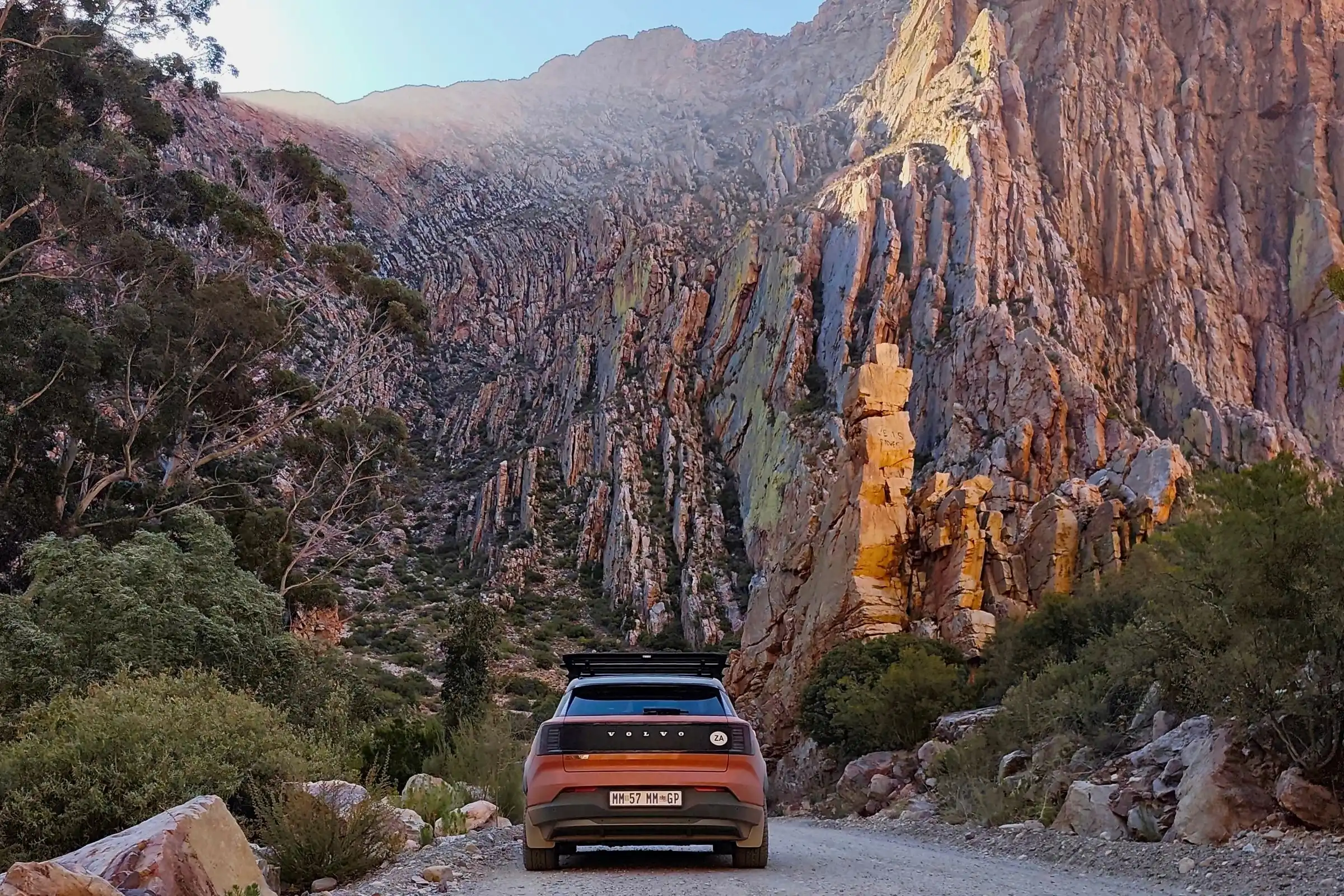
TOP The Swartberg Pass is one of South Africa’s most-loved driving routes ABOVE “37 kilometres in two hours?” you think when you see the Gamkaskloof sign. Then you come to this. It took us almost three hours IMAGE Justus Visagie
Why exactly is Gamkaskloof called Die Hel?
It wasn’t called Die Hel by accident. Its name is most often credited to a stock inspector named Piet Botha, who descended via the notorious route known as Die Leer in the 1940s and was not complimentary about the experience. The residents themselves have always preferred Gamkaskloof, and refer to themselves as Klowers, from the Afrikaans word for canyon dwellers.
Temperatures in the valley, cupped between the Swartberg’s folded quartzitic sandstone walls, can be punishing in summer (the highest recorded temperature by the weather station there was 42.1°C).
The single road that connects Gamkaskloof to the outside world is 40,5 kilometres of rocky, corrugated track descending from the Swartberg Pass. It is not a road so much as a prolonged negotiation with gravity and geology. People have been making that negotiation since 1830, when a small community settled in the valley and stayed, more or less cut off from the world, for over a century.
CapeNature manages the reserve. The Joubert family runs the accommodation. And in January this year, before severe flooding closed the road for months, a Volvo EX30 Cross Country in an orange vinyl wrap became what is probably the valley’s first electric visitor.
Whether that was brave or foolish depended entirely, as we were about to discover, on the state of one battery.
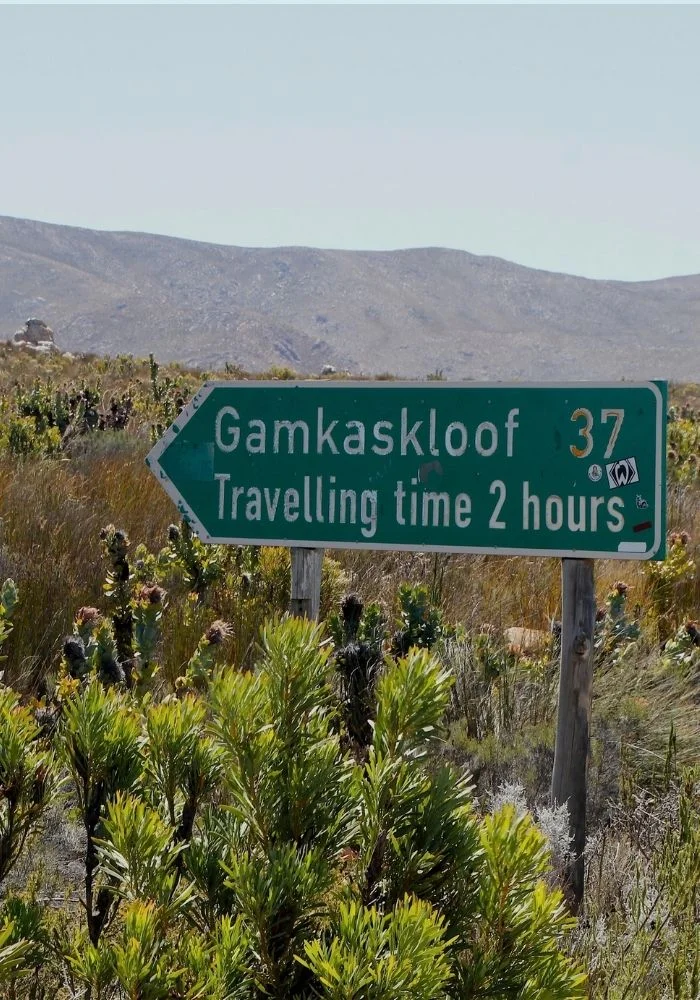
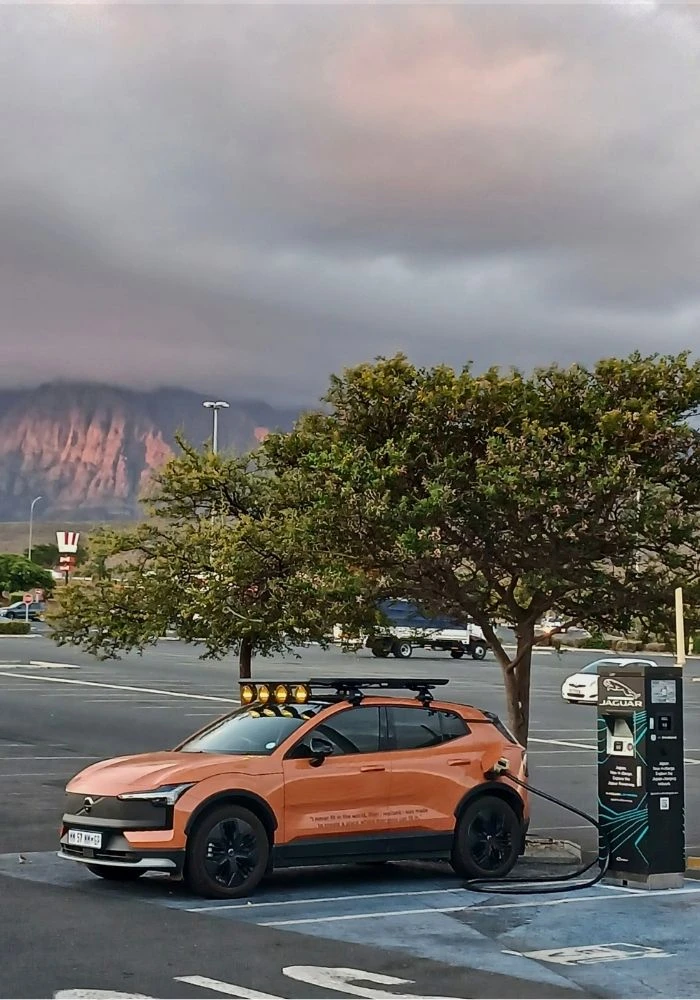
From left The sign at the top of the pass beggars belief; EV charging infrastructure is growing rapidly IMAGES Justus Visagie
Charging an EV between Laingsburg and the Swartberg Pass
We had come from De Doorns, where we’d spent the night without charging.
The original plan had been to approach via Seweweekspoort, one of the Cape’s great gorge roads. We charged at the GridCars fast charger at the Laingsburg Engen, and that, at least, went to plan.
From there we should have turned south on the R323, threading through the magnificent gorges of Seweweekspoort before joining the road to Aloe Valley. Instead, I carried on east along the N1, on autopilot and increasingly aware that something was wrong.
By the time I acknowledged the error, we were too far gone to double back. A detour through Prince Albert it would have to be: up the northern side of the Swartberg Pass, across the plateau, and down the southern side to Aloe Valley. It was spectacular. It was also expensive in kilowatt-hours.
We passed the turn-off to Gamkaskloof on the way down, arriving at Aloe Valley Retreat, near Matjesrivier, at about five in the afternoon with the battery running low, and had the car plugged in by half past five.
Aloe Valley is a lovely place close to Oudtshoorn, and its domestic wall socket delivered a steady 1.9 kilowatts through the night. By the following afternoon we had reached 70 percent, the ceiling recommended by Volvo, whose engineers had issued a precautionary recall notice on the battery management system.
There was another complication: the car was intermittently reluctant to start. Tapping the key fob against the dashboard pad could take several attempts before the car came to life. Nevertheless, at 13:30 on Sunday we unplugged, turned north, climbed the Swartberg Pass again, and turned left towards The Hell.
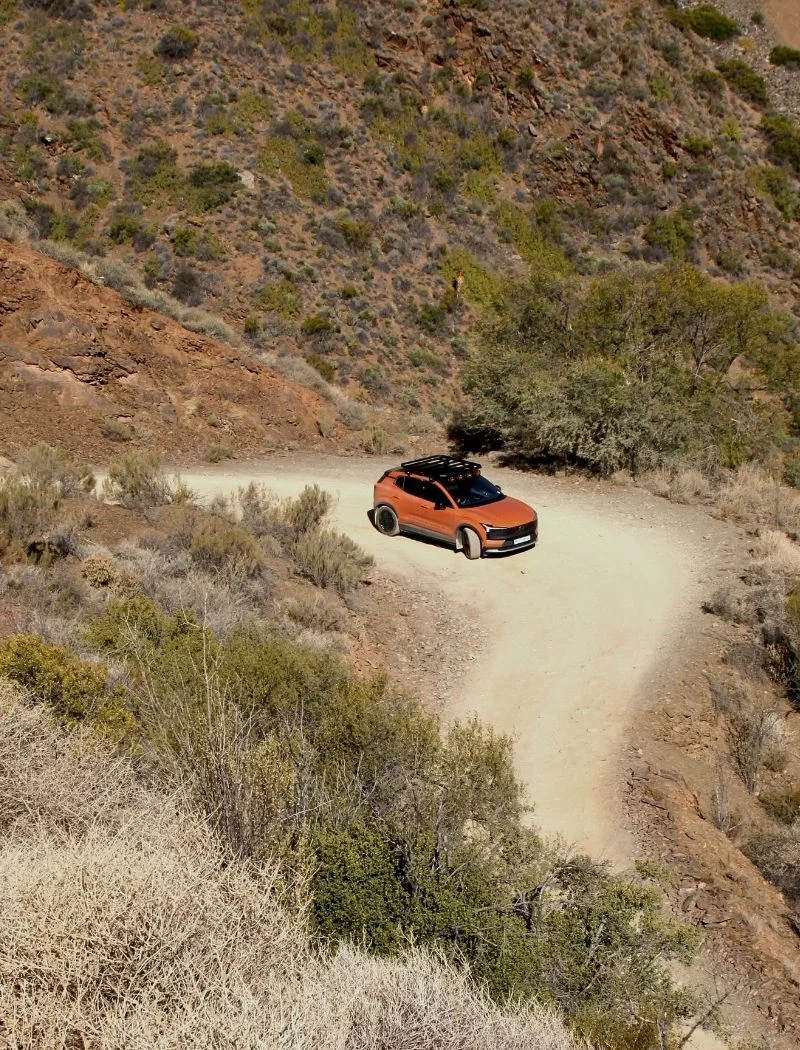
We made our way slowly, gingerly down towards the Gamkaskloof valley IMAGE Justus Visagie
Can a Volvo EX30 Cross Country handle the road into Die Hel?
To be fair to the EX30 Cross Country, it’s not marketed as an off-road vehicle. Volvo pitches it as a crossover with enhanced suspension and all-terrain tyres, closer in character to an Audi Quattro than a Land Cruiser, built for gravel roads, light snow, and coastal tracks rather than the kind of rocky descent that Gamkaskloof demands.
The EX30 Cross Country has an official range of 427km, but the all-terrain tyres and the demands of off-road driving took a heavy toll, and the onboard computer sometimes showed as little as 330km of range on a full or nearly full battery.
The pass had been rougher than usual. Gravel roads shift and degrade with rain and traffic, and whoever dismisses this particular track as easy is probably remembering a different year. I’d ridden it before on a Honda CRF250L trail bike. This was not the same road.
EXPERIENCE Walk with this cultural botanist and you’ll never see plants as ‘just plants’ again
What we hadn’t expected to see was the wildlife. Along the track, klipspringers and grey rhebok watched us pass with complete indifference. The rhebok kept their distance; the klipspringers were considerably cheekier. Our range anxiety receded briefly.
On the rocks in the road we also found, at intervals, neat cairns of baboon droppings arranged with almost comic precision, identical to the poo emoji. We never saw the baboons themselves. Only the evidence. Gamkaskloof is a CapeNature reserve, and so has a strong conservation focus.
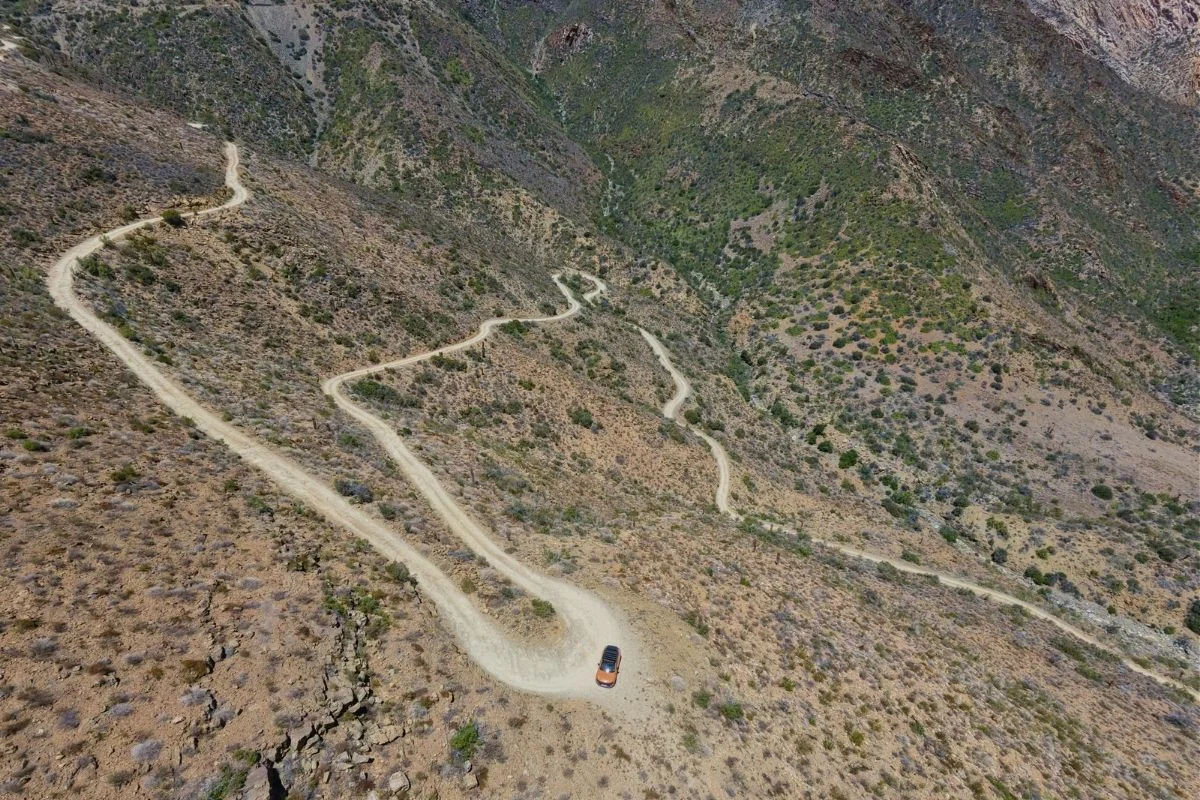
The winding road looks like manageable gravel from the air, but is full of dangers to the underside of a vehicle IMAGE Justus Visagie
I had dropped the tyre pressure from 2.6 to 1.8 bar to soften the ride, which also lowered the car’s already modest 180mm ground clearance by a marginal, but consequential amount. Five or six times, on the worst of the rocky steps and sunken ruts, the car’s belly met the road with a sound that made us wince.
Pieter Joubert, who runs the accommodation at Gamkaskloof with his wife Marinette, would later advise us to drive closer to the road’s edges on the way out — the surface was less degraded there, he said. It was useful local knowledge.
We arrived at our cottage with 35 percent charge remaining.
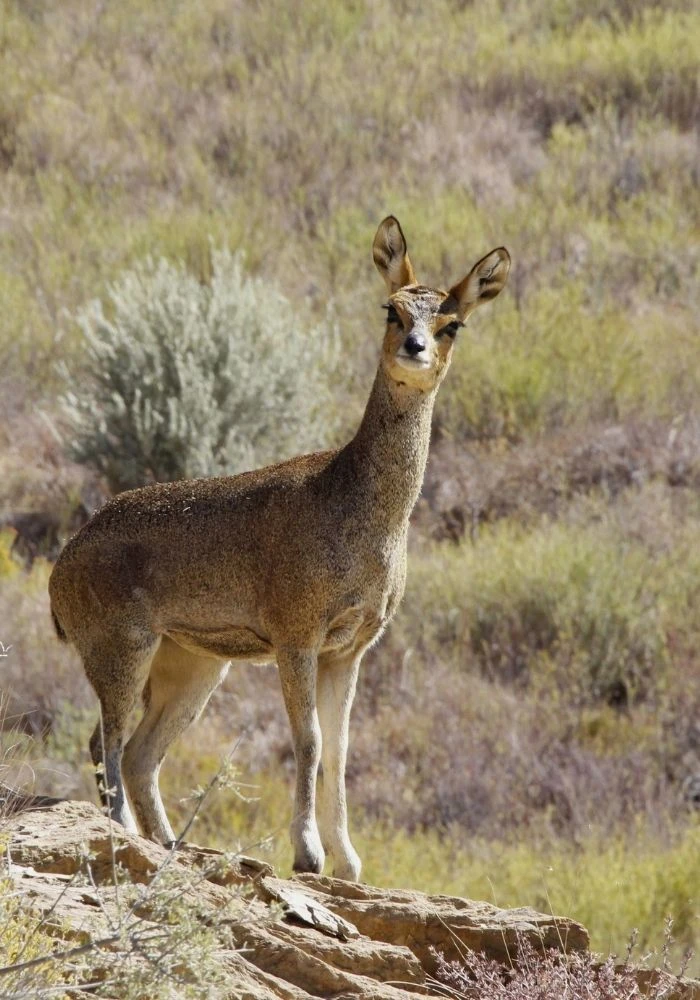
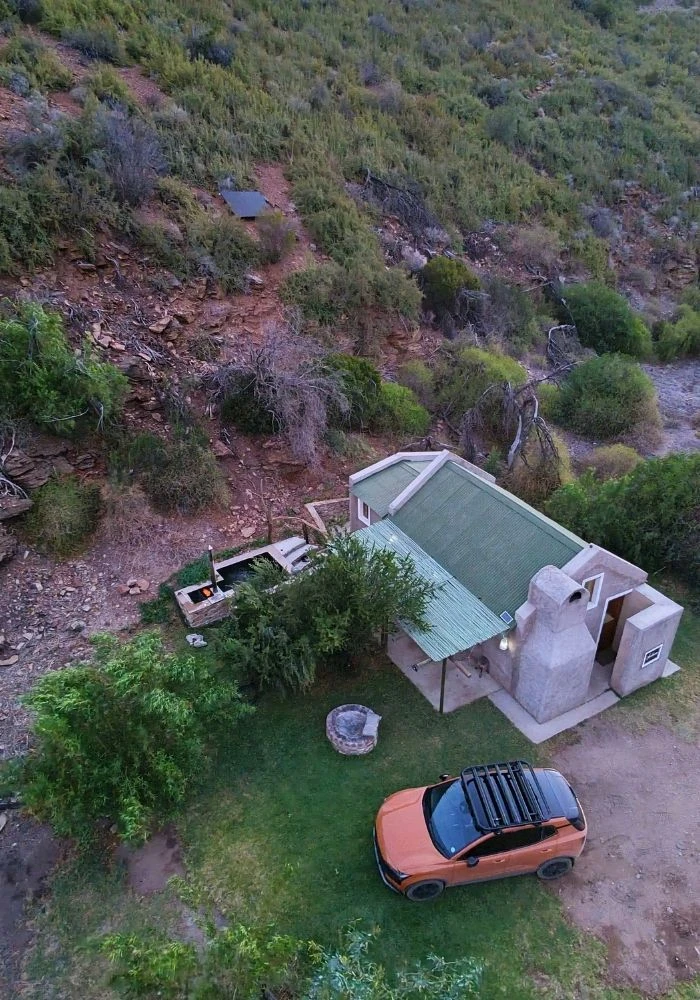
FROM LEFT A klipspringer watches our progress unconcerned — at our speed, no-one feels threatened; the plunge pool at Spekboom Cottage is where you’ll want to spend the evening IMAGE Justus Visagie
Staying at Gamkaskloof: Spekboom Cottage and an off-grid charge
Spekboom Cottage is tucked up against a koppie at the valley’s edge. It’s a modest, rustic space where bedroom and kitchen share one room and the outside stoep is where life happens.
There is no signal. There is no wifi. There is, however, a sturdy wood-fired plunge pool that reaches a deeply satisfying temperature by nightfall, and above it, on a clear January night, enough stars to make you forget everything else.
The battery could wait until morning.
We approached Pieter for help. He tried the generator first; it puts out around three kilowatts, which should have been sufficient. The EX30 wanted nothing to do with dirty generator power. The charge indicator turned red and stayed there.
So Pieter tried something else. He cleared a path to a building at the back of the property and connected the car directly to his solar inverter and battery system: nine panels and a 10 kilowatt-hour battery that runs the farm’s operations and keeps the cold storage working.
This, the car accepted. We charged for a few hours and climbed from 35 percent to 46. Modest progress at 1.9 kilowatts into a 49,2 kWh battery, but enough.
For Pieter, there was something in the experience too. He now knows that a summer visit from a modestly sized EV battery will not collapse his microgrid, that the cold storage and the guest accommodation and the car can share the harvest of those nine panels without creating a crisis.
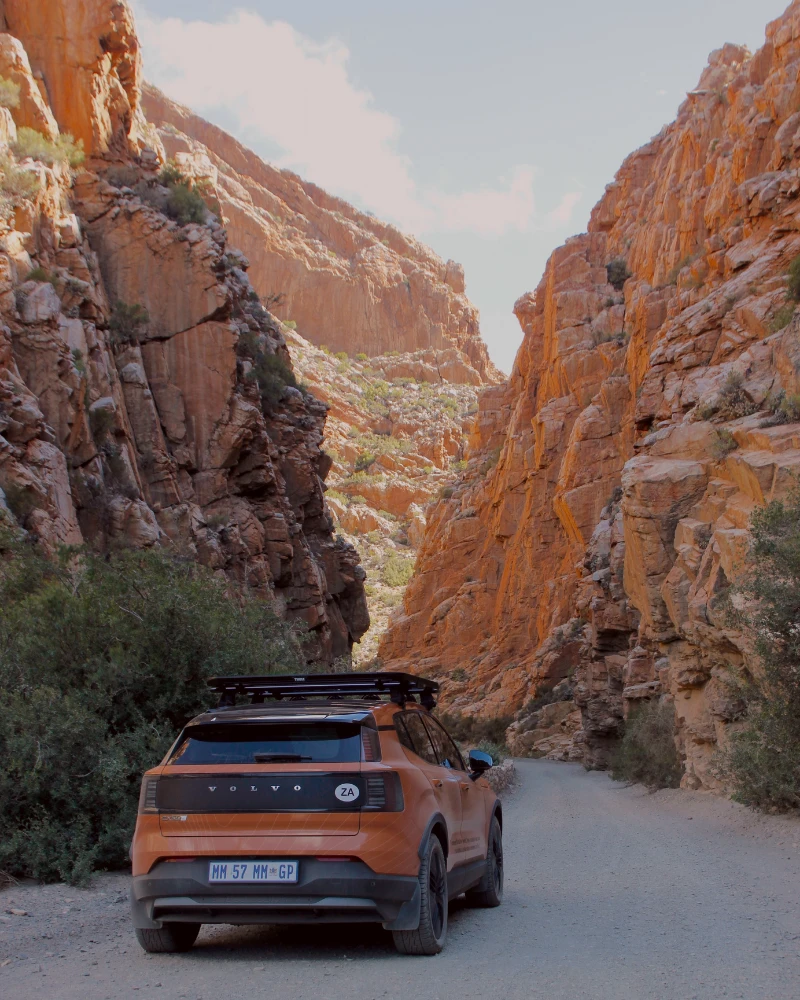
Heading back out with a low battery, we were grateful for the regenerative braking capability of the Volvo EX30 on the descent IMAGE Justus Visagie
Leaving Gamkaskloof on 46 per cent
Google Maps had been reassuring about the trip out. Once up the Elands Pass and onto the plateau, it would be largely downhill to our next stop, Bushman Valley near Prince Albert. On paper, 46 percent was enough.
The terrain told a different story. For every descent there was a climb to match, and the battery dropped with familiar, dispiriting speed. By the time we reached the summit turn-off for the Swartberg Pass, we were at 10 percent.
What saved us was physics. The northern descent of the Swartberg is long and steep and the EX30’s regenerative braking works hard on exactly this kind of road, converting kinetic energy back into stored charge with every kilometre of downhill. We coasted into Bushman Valley just after 5pm with enough charge to spare, plugged into a domestic socket at six, and did not unplug until the following morning.
From Prince Albert it was Laingsburg for a top-up, then Worcester for a longer charge. There, the recall notice notwithstanding, I pushed the battery to 90 percent, because the Hex River Pass lay ahead and our tolerance for further range anxiety was exhausted.
The EX30 descended the Hex River Pass with the calm assurance it had shown throughout. This is a car that has now driven up and down Sani Pass, traversed the Tankwa Karoo, and gone to Die Hel and back. It arrived home with no warning lights and no visible damage.
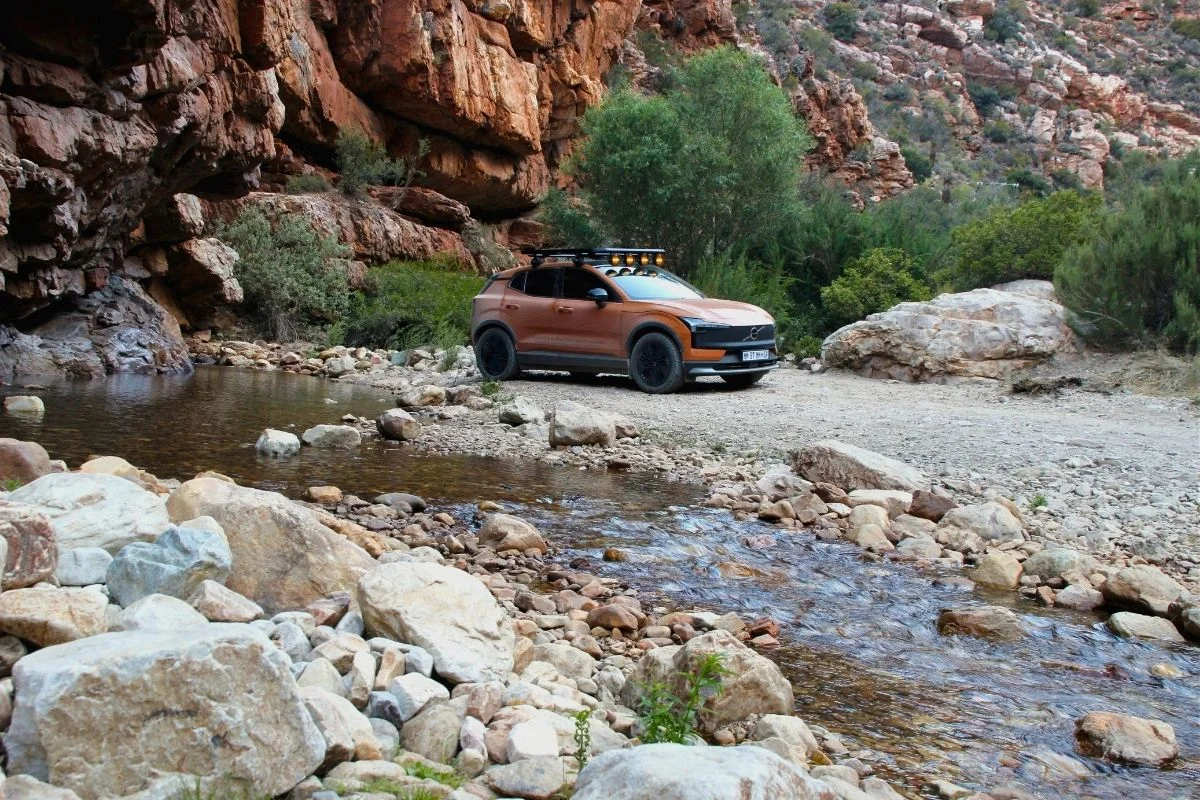
While the clearance of the EX30 is a little on the low side for a trip to Die Hel, it’s still a robust vehicle IMAGE Justus Visagie
Why remote accommodation needs EV chargers (please Patricia de Lille)
When Marinette Joubert posted a few photographs and a short note about our visit on Facebook, the response was mixed. Some people thought it was an interesting thing to have done. Others questioned whether the trip amounted to much of an achievement at all. They were right, in a sense. We weren’t proud so much as curious. The infrastructure gap, it turned out, was the real story.
Minister Patricia de Lille’s Tourism Month address, delivered in Durban on 13 August 2026, called on government, business and technology to work together to grow domestic tourism. It is the right instinct, though the words ‘electric vehicle’ and ‘charging infrastructure’ appeared nowhere in it. The barrier is lower than most people assume.
Many remote accommodation businesses fall below the VAT registration threshold and cannot reclaim the VAT on a charger installation. Allowing them to do so, or including chargers in existing tourism grant programmes, would cost the department very little. The adventurous domestic traveller arriving in an EV is exactly the visitor these places are waiting for.
A 7kW AC charger of the kind that can be installed alongside a solar system for a reasonable once-off cost would have changed this journey entirely. More than three times faster than a domestic socket, it would have returned us to the plateau with 70 percent charge instead of 46. Our range anxiety that shadowed the entire trip would have been, if not eliminated, at least managed.
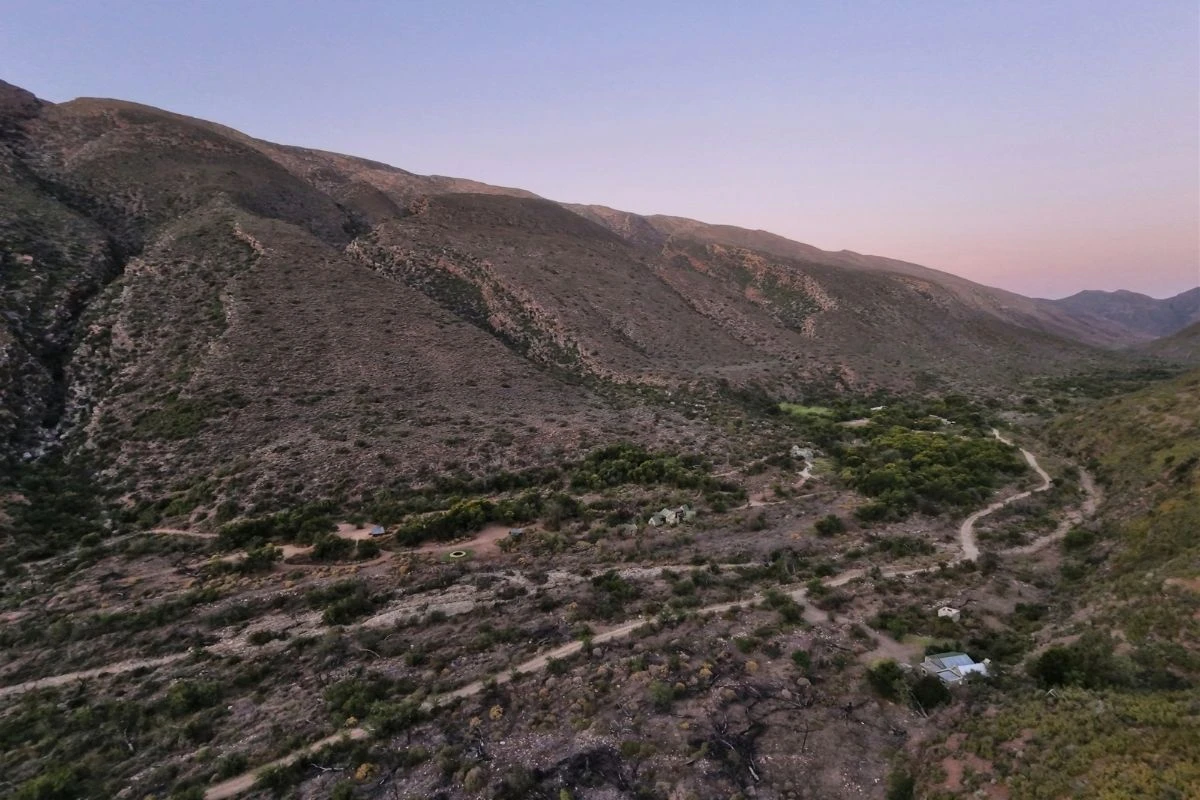
The bottom of the valley, not that the road gets any easier IMAGE Justus Visagie
Electric car vs diesel SUV: Cost and carbon footprint on a 1 000km trip
At a blended rate of roughly R5 per kWh across a mix of domestic and fast charging, the electricity for the full 1 000km trip costs around R1 250. A Toyota Fortuner covering the same distance at 10 litres per 100km, with diesel at R27 per litre, would cost around R2 700 in fuel alone.
The tourism opportunity is real. Adventure-seeking EV drivers are looking for exactly these places. What they need, and what remote accommodation owners could offer without enormous expense, is a proper AC charger.
On South Africa’s coal-heavy grid, the EV advantage is modest, but noteworthy: roughly 25% less CO2 per kilometre than a large diesel SUV. That gap widens further when you factor in the upstream emissions from refining and shipping imported crude oil, costs that have no equivalent in South Africa’s largely domestic coal supply chain.
The substantial gains come as the grid cleans up, or when more of the charging happens from solar. Pieter’s nine panels and the roof-mounted solar at Worcester’s Mountain Mill shopping centre nudged our carbon footprint in the right direction.
The EV landscape is shifting rapidly. The next generation of electric vehicles will push this progress further. The Volvo EX60, for instance, is expected to offer a real-world range exceeding 700km, more than enough to reach Gamkaskloof from Cape Town and back without a single charge stop — and without a moment’s range anxiety.
DETAILS
What it cost to charge At roughly R5 per kWh across domestic and fast charging, electricity for the full 1 000km trip costs approximately R1 250.
Stay Spekboom Cottage is one of several accommodation options in Gamkaskloof, all managed by Pieter and Marinette Joubert, who also run a small restaurant and shop in the valley. To book, WhatsApp Marinette on 072 355 9623, email info@gamkaskloof.co.za, or find them on Facebook.
Getting there The turn-off to Gamkaskloof is on the Swartberg Pass road (R328) between Prince Albert and Oudtshoorn. From the turn-off it is 48km to the valley floor, much of it challenging gravel. The Elands Pass itself is less than 3km long, but the road continues for another 19km or so after the foot of the pass before you arrive. Allow 2 to 2.5 hours, but there is no need to rush. Note that the road was closed for several months after severe flooding in early 2026 and has since reopened; check conditions with Marinette before setting out. Leave early, take a picnic and stop to admire the scenery. There are tortoises, baboons and klipspringers, all vulnerable to fast-moving vehicles. Please slow down for them.
EV drivers should know The fast charger closest to Gamkaskloof is at Laingsburg (GridCars, at the Engen), roughly a 150km drive via Prince Albert. There is no dedicated EV charging in the valley. The accommodation runs on off-grid solar. If you’d like to use Pieter’s solar system for charging, discuss this with him before setting out, and do not assume it will be available on arrival without prior arrangement. A domestic 15-amp socket will deliver approximately 2kW. Aim to arrive with a range reading of at least 300km on the dashboard; the road consumes considerably more energy than Google Maps predicts.
Reducing tyre pressure for the track softens the ride but also reduces ground clearance. The EX30 Cross Country’s 180mm clearance is workable on this road but leaves little margin. Some drivers hug the road edges where traffic is lighter, but be aware that the verge can scratch your paintwork. Proceed with caution either way.