

Whale watching in Gansbaai in three-metre swells (with a pill and paper bag)
We went looking for the Marine Big 5 with Marine Dynamics. It's a day I won't forget

- Sonya Schoeman
WHY WE LOVE THIS TRAVEL EXPERIENCE
Marine Dynamics is a well-oiled machine, having had 27 years to figure out what works. Our excursion began at the African Penguin & Seabird Sanctuary, a stop I recommend because it’s astounding to learn about the scale of change that led to African penguins being listed as critically endangered, and encouraging to see what’s being done to turn that around. Every whale-watching trip starts at the Great White House, another spoke in the Marine Dynamics wheel, with soup and bread rolls (good to have something in the stomach before heading out). Then it’s onto the boat. There were plenty of staff on board, attentive and ready to help. When one heard I get seasick, they led me to the steadiest place to sit: on the lower deck, towards the centre. The fact that each trip out gathers information that contributes to conservation is what impressed us, too.
SUSTAINABILITY PROFILE
Marine Dynamics is fully committed to the well-being of its entire ecosystem in the Gansbaai area. It has a strong community outreach programme, a robust research programme that has contributed to more than 40 peer-reviewed scientific papers, and a marine rescue team (on the day I interviewed Head of Research Dr Loraine Shuttleworth she had to rush a shark-bite victim—an African penguin—to a specialist vet). The African Penguin & Seabird Sanctuary rehabilitates injured and oil-soaked birds. DICT runs monthly beach clean-ups and installs fishing-line bins and storm-drain nets, and its DEEP programme takes local learners through three years of environmental education, according to its impact reports. Marine Dynamics is certified by Fair Trade Tourism and the Centre for Responsible Tourism.
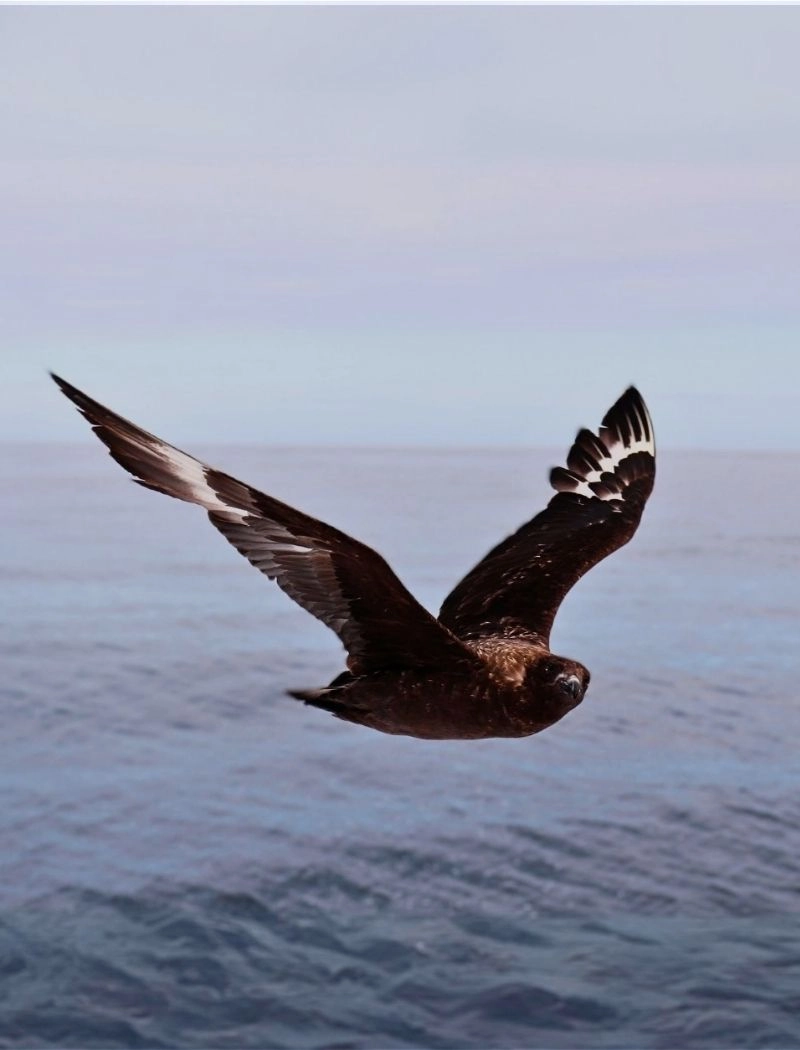
MAIN IMAGE A Southern right whale raises its flukes before diving off the Overberg coast ABOVE A brown skua flies alongside the boat, keeping up with ease IMAGES Courtesy Marine Dynamics
Whale watching and the Marine Big 5 in Gansbaai
On the day I went whale watching in Gansbaai with Marine Dynamics, the swell was three metres high.
Now, there are four kinds of people in the world: those who like to be in the sea, those who like to be on the sea, those who’ll take the sea whichever way she comes, and those who’d rather not be anywhere near her at all.
I belong in category one. Category two, from real-life experience, is a hard no.
I was clear about this before I boarded Dream Catcher, but out of journalistic curiosity and integrity, I took a positive attitude and popped a Stugeron the recommended two hours before departure. I felt upbeat. All would be well.
I was sure of it.
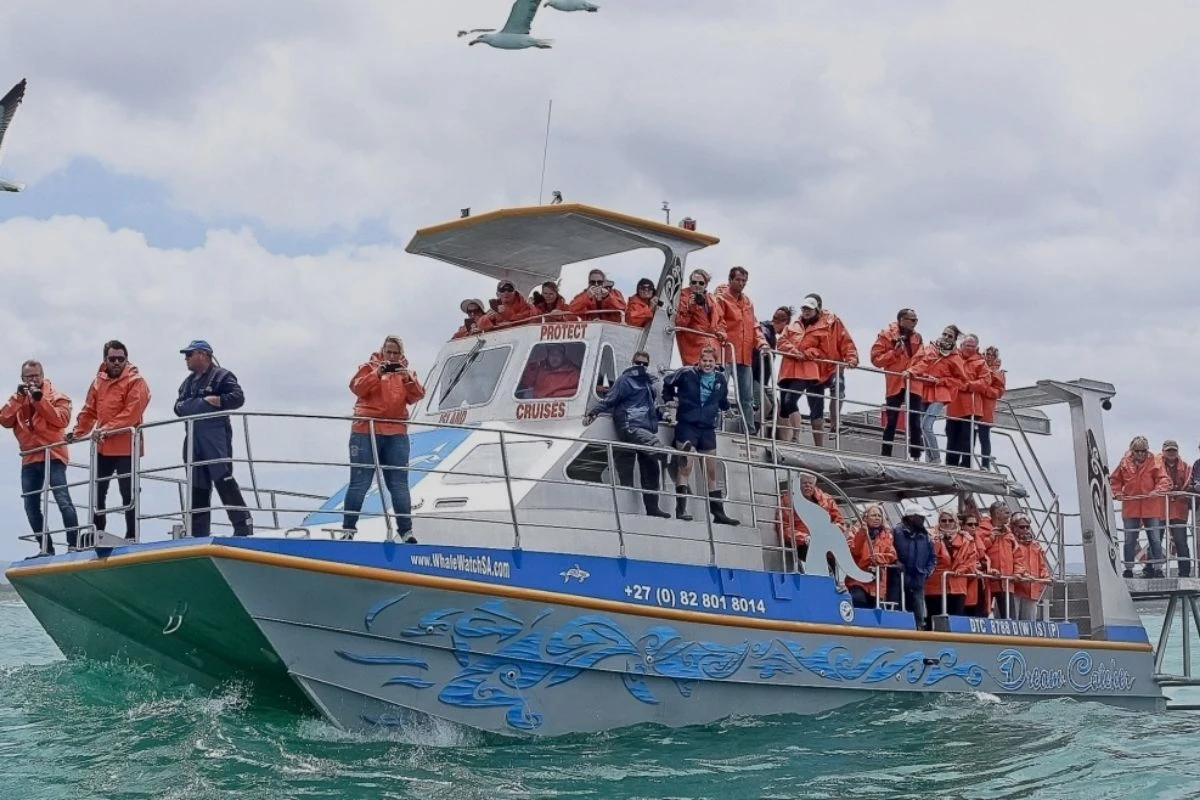
A full house on Dream Catcher. Not everyone on board is a tourist: the trip doubles as a research platform IMAGES Courtesy Marine Dynamics
How rough is whale watching in Gansbaai?
It depends on the day. On mine, it was a rollercoaster, some of which was thrilling. Three-metre swell means stomach-lurching dips, followed by highs one doesn’t expect. The way out of Kleinbaai harbour is narrow, with jagged rocks standing as warning sentries on either side. Marine Dynamics skippers are skilled, I’ll give them that.
Once we were clear, a brown skua fell in alongside the boat. It flashed its downy belly, then dipped down, soared up and crisscrossed overhead, then dipped down and (I swear) regarded us as if to say, this could be so effortless — grow some wings, people.
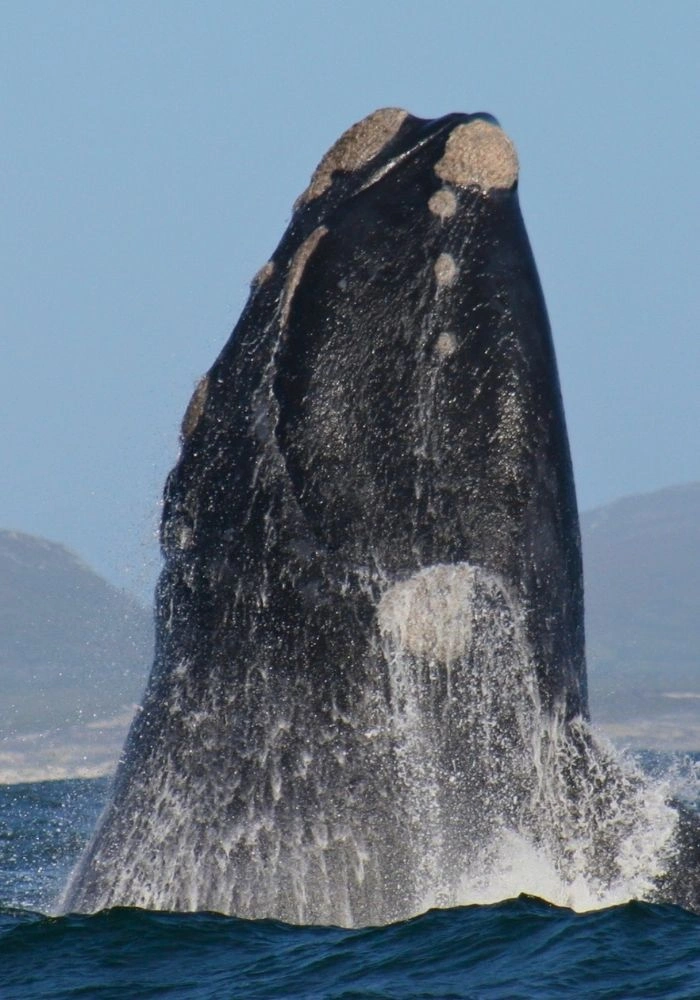
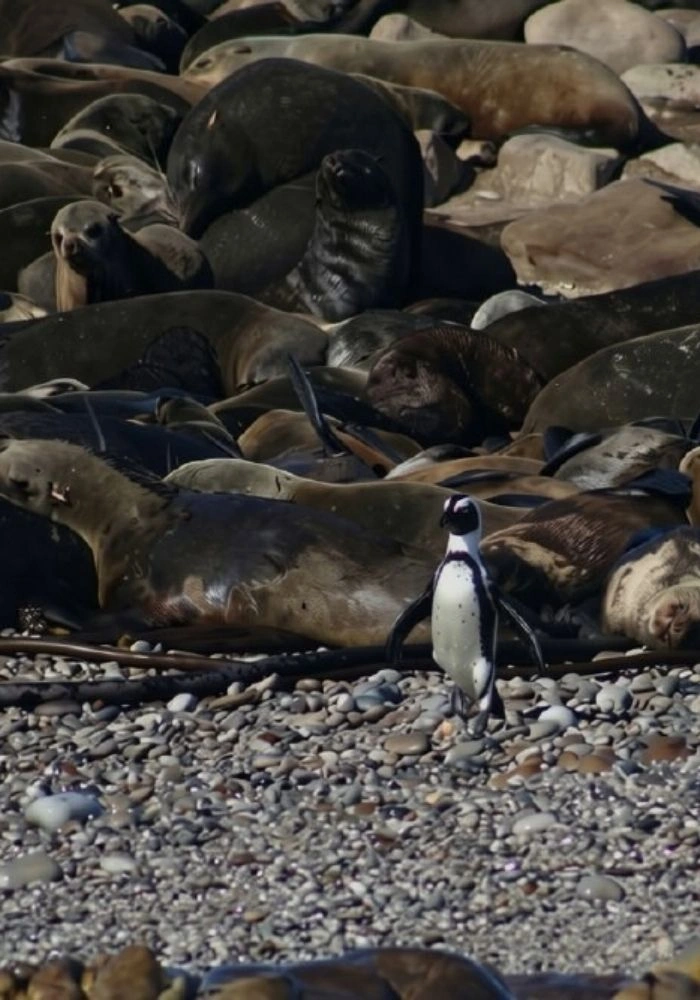
FROM LEFT A southern right whale (Eubalaena australis) breaches head first off Gansbaai; Cape fur seals crowd the rocks of Geyser Rock while a lone African penguin gazes out to sea IMAGES Courtesy Marine Dynamics
Shark-cage diving, chum and is it ethical?
First stop was the shark-cage diving boat, the likeliest place to tick off the first of the Marine Big 5. Sure enough, a bronze whaler’s dorsal fin broke the murky surface, glinting wet in the sun, drawn in by the scent trail of chum. It’s a mix of fish offcuts and oil, held in a container on a rope and tossed overboard at regular intervals.
Chum scent is not subtle. It drifted, generously, across the water to us. To a shark, the scent irresistible, but on Dream Catcher, a revolution was brewing in human stomachs. Attentive, sympathetic guides discreetly handed out two paper bags to children. The third was for me.
INTERVIEW Every plant is a clue: How a SANBI scientist makes sense of the world around him
I’d never cleared up for myself the question most people ask: Is this chumming and is it good practice? A few days later, I asked Head of Research Dr Loraine Shuttleworth.
“A big concern people often have is that we’re feeding the sharks and that’s unnatural.” There’s no feeding involved, she assured me.
Another concern people have, she said, it’s unnatural to lure them to the area. “But if you look at the arrival time—how long it takes for the sharks to show up—it’s sometimes even less than a minute. So they are already in the area.”
The team has also learnt that sharks have personalities. Some hang around out of curiosity. Others aren’t interested and swim off to forage. “That’s sort of the beauty of cage diving,” says Dr Shuttleworth. “They are in their natural environment.”

A bronze whaler shark (Carcharhinus brachyurus), also known as the copper shark, surfaces beside a shark cage diving vessel off Gansbaai IMAGES Courtesy Marine Dynamics
Where your money goes: Marine Dynamics and the Dyer Island Conservation Trust
The Marine Dynamics operation is a thorough ecosystem. Wilfred Chivell began in the business of whale watching more than 25 years ago when he won the first permit to do so in Gansbaai.
Today there’s also shark-cage diving tours, the Marine Dynamics Academy offering academic and field-based training modules, the African Penguin & Seabird Sanctuary, and the Dyer Island Conservation Trust (DICT). The latter runs research and conservation programmes to protect biodiversity in the area.
Dr Loraine Shuttleworth explains, “Very often with marine research you have an issue with funding, because boats are expensive, fuel is expensive, crew is expensive. So what we do is, when we have our trips going out, we have the research happening at the same time and then you overcome that issue of ‘we don’t have funding, so we can’t do the research and therefore we can’t do conservation’.”
So “your trip is not just for tourism, it’s for research and conservation” says Shuttleworth. It’s genius, really.
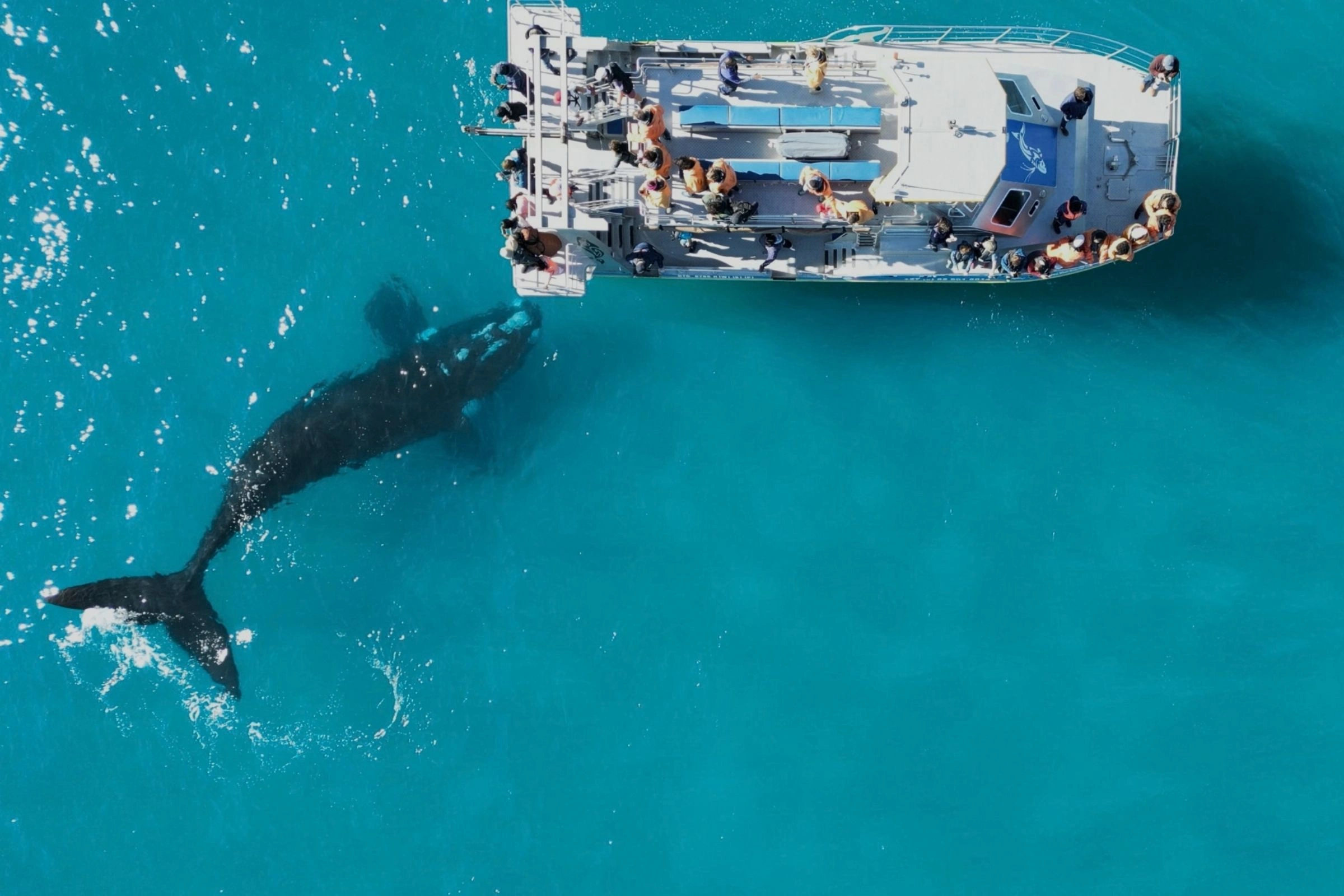
Dream Catcher, Marine Dynamics’ whale-watching vessel, sits in clear water as a whale dives beneath the hull. Permit holders may approach whales to within 50 metres, and the whale can then choose to come closer IMAGES Courtesy Marine Dynamics
What, exactly, counts as the Marine Big 5?
The Marine Big 5 mix individual species with whole groups of animals: African penguins, Cape fur seals, whales, dolphins and sharks.
Here’s how our boat scored.
- African penguin (tick)
- Cape fur seal (tick)
- Whales: three baleen species visit this coast. They are the humpback, the southern right (tick) and Bryde’s whale (pronounced ‘broo-des’, with the ‘es’ firmly articulated).
- Dolphins: common, humpback and Indo-Pacific bottlenose.
- Sharks: bronze whaler (tick), broadnose sevengill and the one this coast is most famous—now infamous—for, the great white. The last time they saw one was in October 2025, says Dr Shuttleworth.
Four out of five, in three-metre swell. I’ll take it.
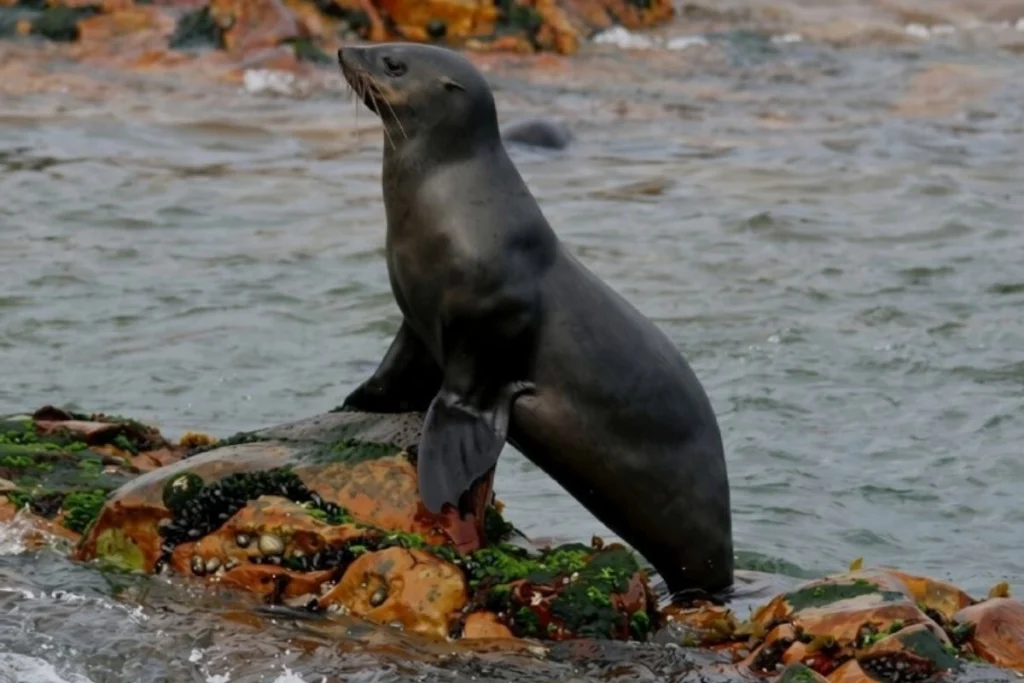
A Cape fur seal (Arctocephalus pusillus pusillus) on Geyser Rock, home to one of the largest seal colonies on South Africa’s south-west coast IMAGES Courtesy Marine Dynamics
How close can whale-watching boats get to whales?
Fifty metres, if the operator holds a whale-watching permit. Without one, boats must stay 300 metres away. The whales, however, may come as close as they like.
The permit exists because “you don’t want anyone that doesn’t know how to skipper around a whale,” says Dr Shuttleworth. “You want an experienced skipper and someone who also respects the animals.”
The number of boats is limited as well. Marine Dynamics is the only operator in its stretch of water, from Kleinbaai to Pearly Beach, while Ivanhoe Sea Safaris operates towards De Kelders. So there’s rarely more than one boat near a whale in that area.
Which is how, at a respectful 50 metres, we met her. And for about 10 seconds, I became category three: the sea was coming the way she liked and I was fine —something longer than a bus, which may have been swimming these waters since before I was born, had just surfaced and, although I only saw a curved back before it slid down to the depths, it was shockingly awe-inspiring.
For a moment, nothing else mattered, not the swell, not the smell of diesel. Then I reached for that paper bag.
DETAILS
WHAT YOU GET Every trip starts at the Great White House in Kleinbaai with soup and rolls; it’s also a chance to do ablutions (recommended especially if you don’t like the confined space of a boat loo). The Marine Big 5 tour runs for two to two-and-a-half hours, depending on sightings and sea conditions. There can be a few a day, and departure times follow the tides; departure times are confirmed the day before. You head out on Dream Catcher, which is licensed for 50 passengers and six crew. If you’re prone to seasickness, ask them for the steadiest seat: lower deck, towards the centre. Avoid the top deck, which sways more. Entry to the African Penguin & Seabird Sanctuary is included, so arrive early. Transfers from Hermanus or Cape Town can be arranged.
COST South Africans: R1 728 for adults, R864 for children under 12. Internationals: R 2340 per adult, R1 725 per child. There’s an optional conservation fee of R150 per person, which goes to the Dyer Island Conservation Trust. Look at the website to find out what conservation activities it invests in.
Website marinedynamics.co.za