

De Wildeveldt: Luxury West Coast stay my discerning mum would declare is quality
Rewilding 2 000 hectares of veld is no small task. In the meantime, visitors here can walk, ride or hike the expansive veld and appreciate the accommodation. No expense has been spared to fit out the villas, and we also love how local business is being supported
- Sonya Schoeman
AT A GLANCE HOW THIS STAY REDUCES ITS IMPACT
Energy usage 74 solar panels, estimated to cover about 80 per cent of demand
Water usage Borehole water desalinated on site; gardens left unwatered; no metering yet
Waste management Food waste composted; refills for bathroom products, olive oil and salt
Culture + community All staff from Darling, formally employed and paid above the average wage
Biodiversity + ecosystems 2 000 hectares being rewilded, starting with invasive Port Jackson willow
Carbon footprint To De Wildeveldt from Cape Town return = 0.01 tCO2
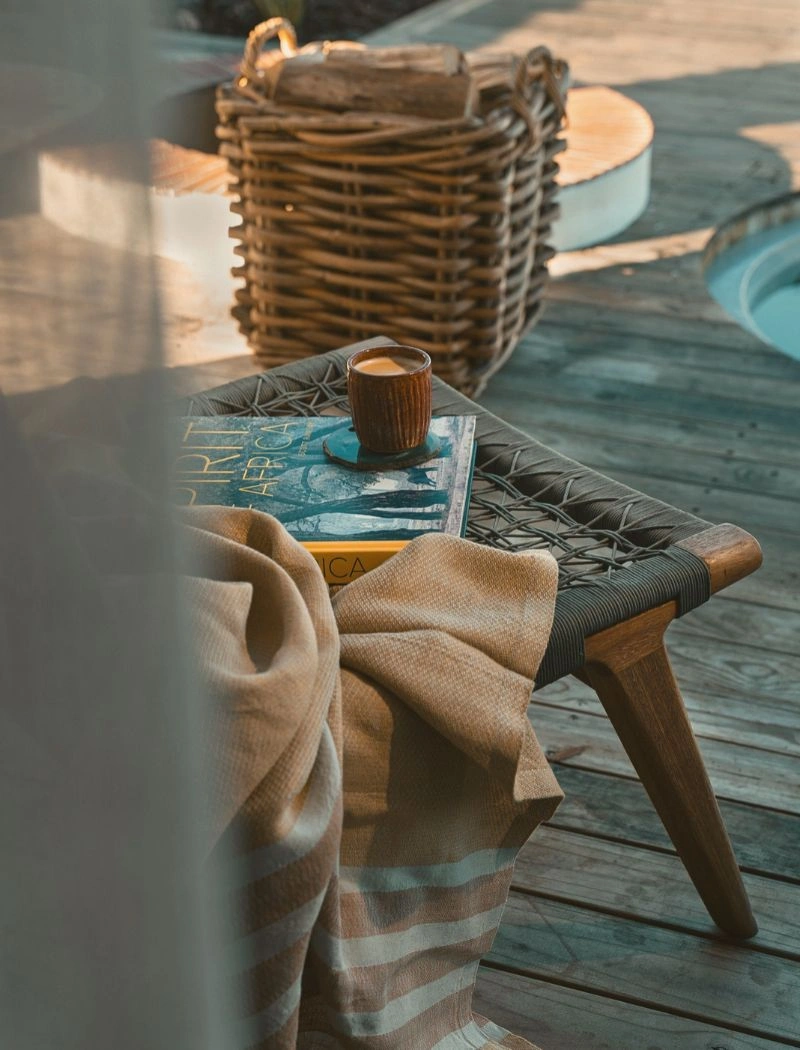
Every element that makes up a De Wildeveldt villa has been carefully selected for its quality, like the Mungo towels in warm tones IMAGE Courtesy De Wildeveldt
How a material snob assesses De Wildeveldt
I’m a material snob. I like Belgian linen for curtains, long-staple cotton or 100 per cent linen for bedding, mulberry silks, wools and cotton velvets. I won’t have synthetic tea towels: they don’t even absorb water. And although I often look embarrassingly like a bag lady in my home office, my bags are never synthetic.
It’s not my fault I’m this way. The flaws of the children are always the fault of the parents – in this instance, my mother.
My mother was a budding clothes designer before she became a farmer, which put paid to that career. Instead, she taught her daughters to sew. Fundamental to that is understanding fabric: what it is, its weight, how it falls and how it wears (important if you want things to last). She knew her fabrics.
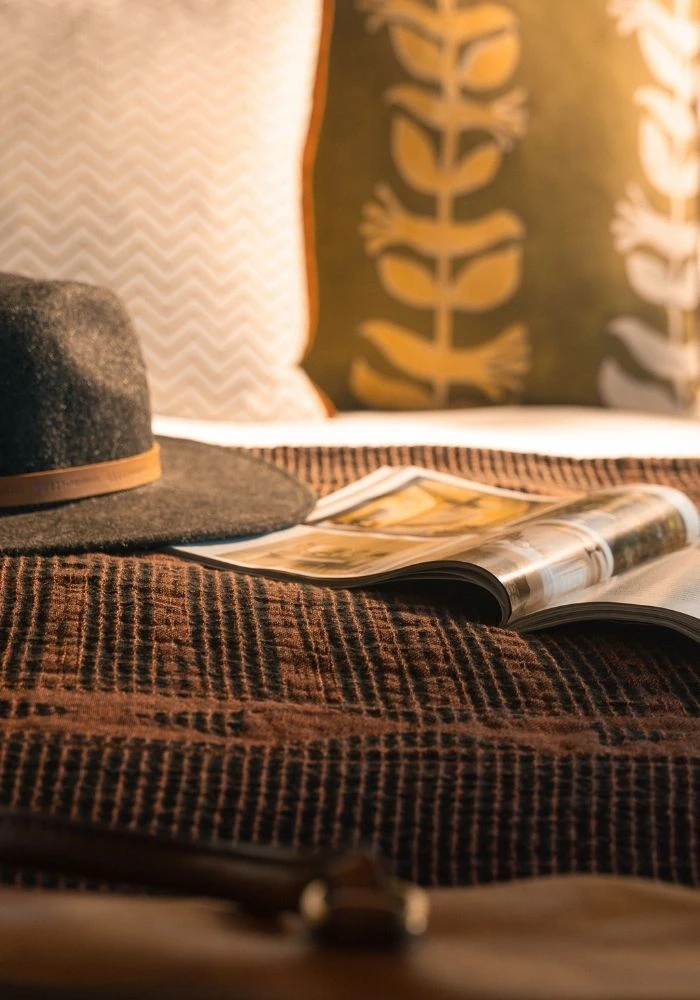
So at De Wildeveldt, she would definitely have noticed the cotton Mungo towels and wraps, and appreciated their refreshing use of colour and pattern. She would have approved of the African jacquard throws on the sofa and, on sitting down, noticed that the sofa itself was covered in a quality upholstery linen.
She would have declared De Wildeveldt a quality place.

The bedroom, with a gorgeous African Jacquard throw, leads out onto the wooden deck, with a hot tub that will keep you pleasantly mellow all evening IMAGE Courtesy De Wildeveldt
Luxury accommodation on the West Coast, endured on the readers' behalf
Although I love quality fabrics and goods – not only because they feel good, but because they last – luxury is not my natural habitat. In fact, it makes me awkward. As a reviewer, I’m almost always hosted, and I’m unlikely to be able to afford a very expensive getaway myself, which can make me feel like a fraud.
But I’m not out here for myself alone. I’m here for three kinds of traveller: those who feel most at home in down-to-earth places they can afford (especially if they travel a lot or have a family); those who, like me IRL, appreciate quality at a mid-range price; and those who love luxury and can afford it, or save up for the occasional spoil. It’s for them I endure the discomfort of every conceivable comfort at De Wildeveldt.
It’s for them I’ll notice that the coffee cups are the work of a clearly excellent potter, and that the rest of the crockery is handmade too, and lovely to handle. It’s for them I’ll register the cutlery’s perfect weight in the hand. And it’s for them I’ll report that the wine glasses are Zwiesel crystal, so that, should you be the type to clink when you say cheers, the ring lingers on, pure as a Tibetan tingsha.

Lorem ipsum dolor sit amet, consectetur adipiscing elit. Ut elit tellus, luctus nec ullamcorper mattis, pulvinar dapibus leo.
Inside the Veld Haus cottages at De Wildeveldt
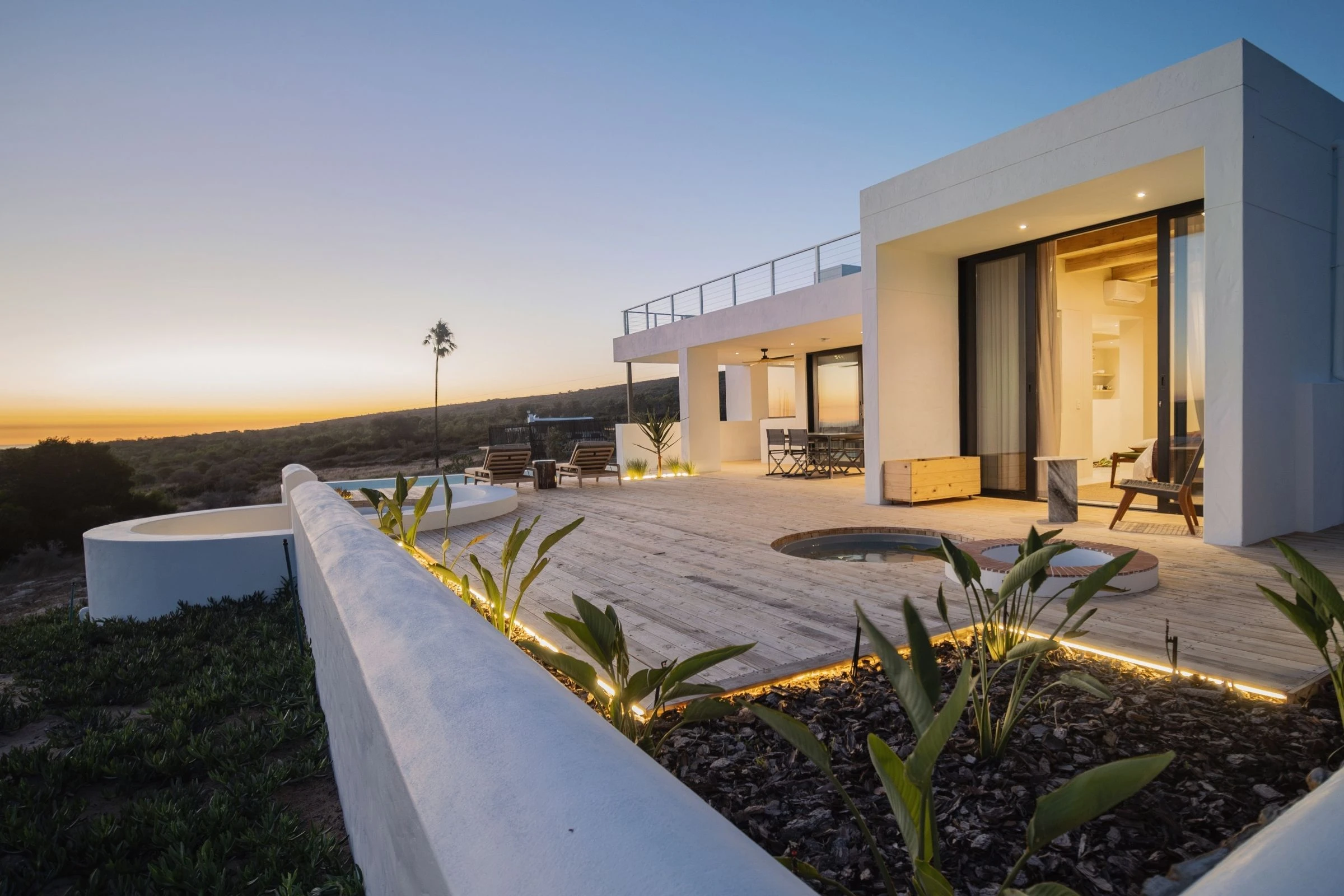
The Veldt Haus cottage is generous. The open-plan lounge and kitchen flow onto a deck with a table and a vast raised daybed. The bedroom opens onto the same deck, into which is sunk a wood-fired hot tub. Staff light it in the afternoon, but we fed it into the evening, using alien vegetation cleared from the former farmland.
There are two showers, one indoors and one out. And there’s a deep oval bath, with scented salts from the local Fynbos range. Judging by luxury influencers, whose feeds always include a lingering bath scene, the wealthy define their stays by their baths.
My mother had another test for quality: the curtains. They should have double seams, a good lining and a generous hem, so that they hang elegantly, pooling slightly on the floor. The curtains here pass. She would have loved the light transparent day curtains too, wafting romantically in the breeze and shielding us from prying eyes.
The only eyes to pry at our cottage, which faced a dry riverbed full of reeds, belonged to the weavers and red bishops swinging in them, and to some Heuglin’s robins in the mornings — my would have called them Hoyglin’s robins (because, German).

An excellent stable is run from the farm. There are horses to suit every level of riding competence IMAGE Courtesy De Wildeveldt
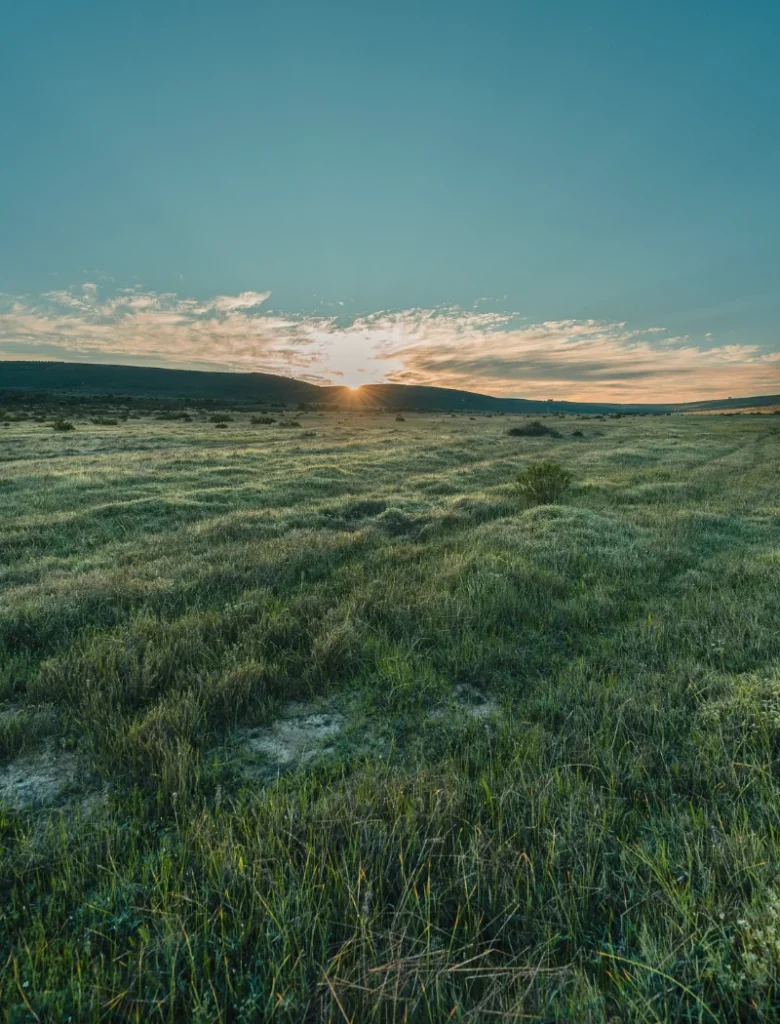
Birding and rewilding 2 000 hectares of former West Coast farmland
There’s plenty of room for birds here. The small dam on the property was loud with Cape weavers, with coots, grey herons, egrets and blacksmith lapwings working its edges, and a lone fish eagle keeping watch.
Occasionally, says Philippa Wood, who heads up the operation, flamingos drop in too. Around the farm we also saw bokmakieries, Cape wagtails, Karoo scrub robins, Cape sparrows, white-backed mousebirds and an African harrier-hawk, while speckled pigeons cooed calmly from sunrise to sunset.
De Wildeveldt covers more than 2 000 hectares of former working farms, and only three units, each sleeping two, currently sit on it. That’s a small footprint on a big piece of land, says Wood. The rest is being rewilded, and that will take years: the Port Jackson willow, now fuelling the hot tub, is plentiful. But the German owner sees it as a legacy project, she says, and he’ll take the time it needs.
We took a drive through the 2 000 hectares, which are safe to hike and mountain bike. Exploring on horseback would be ideal: West Coast Horse Trails is based on the farm, with horses to suit novice and experienced riders.
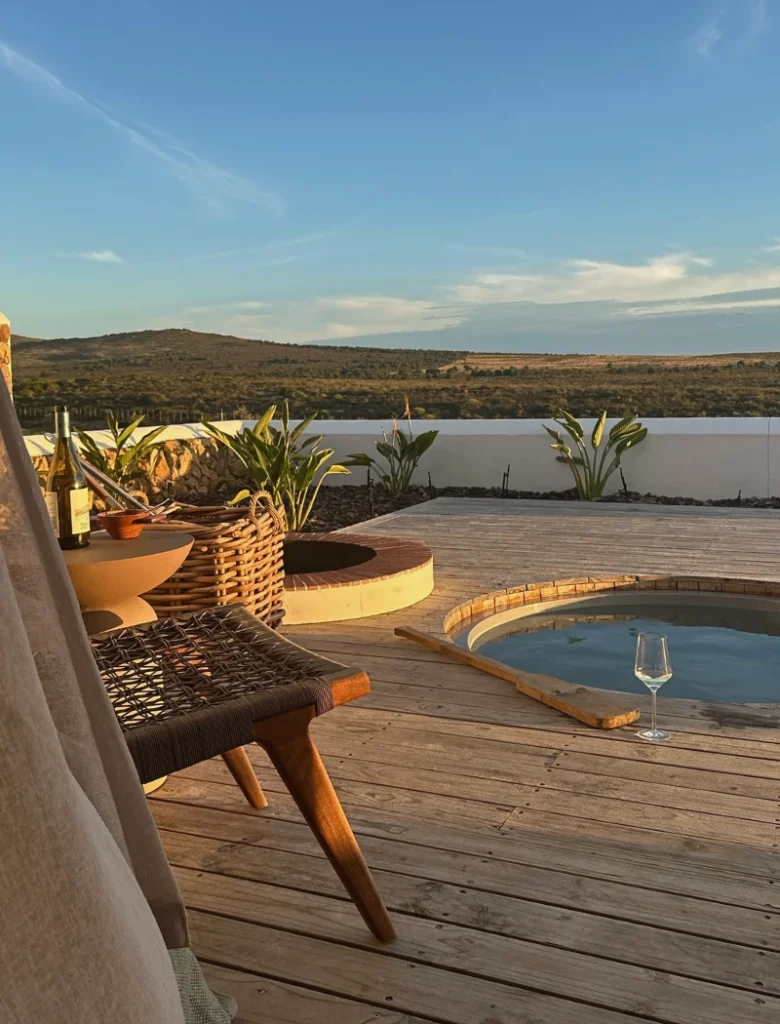
FROM LEFT The deck has about five ‘relax’ settings, from the hot tub to the pool or braai area; the walks on the farm are spacious, no running up against fences IMAGE Travelosophy, De Wildeveldt
It's self-catering, but they provide some excellent products from Darling as a welcome gift
It’s self-catering, and the kitchen has an exceedingly good convection oven. It came stocked with six fresh eggs from the farm’s small brood of chickens, and the cottage usually comes with a few treats. Wood believes strongly in supporting local, so the treats come from Darling and surrounds.
There were wines by Darling Cellars, a satisfying Withington Voorkamer brandy and lime cordial by PipsiMoon Kitchen (so fresh with sparkling water). There was also granola by Evita se Perron Bakery, yoghurt by Darling Romery, three olive oils by Darling Olives, and absolutely delicious spekulaas biscuits baked by a local mother and son.
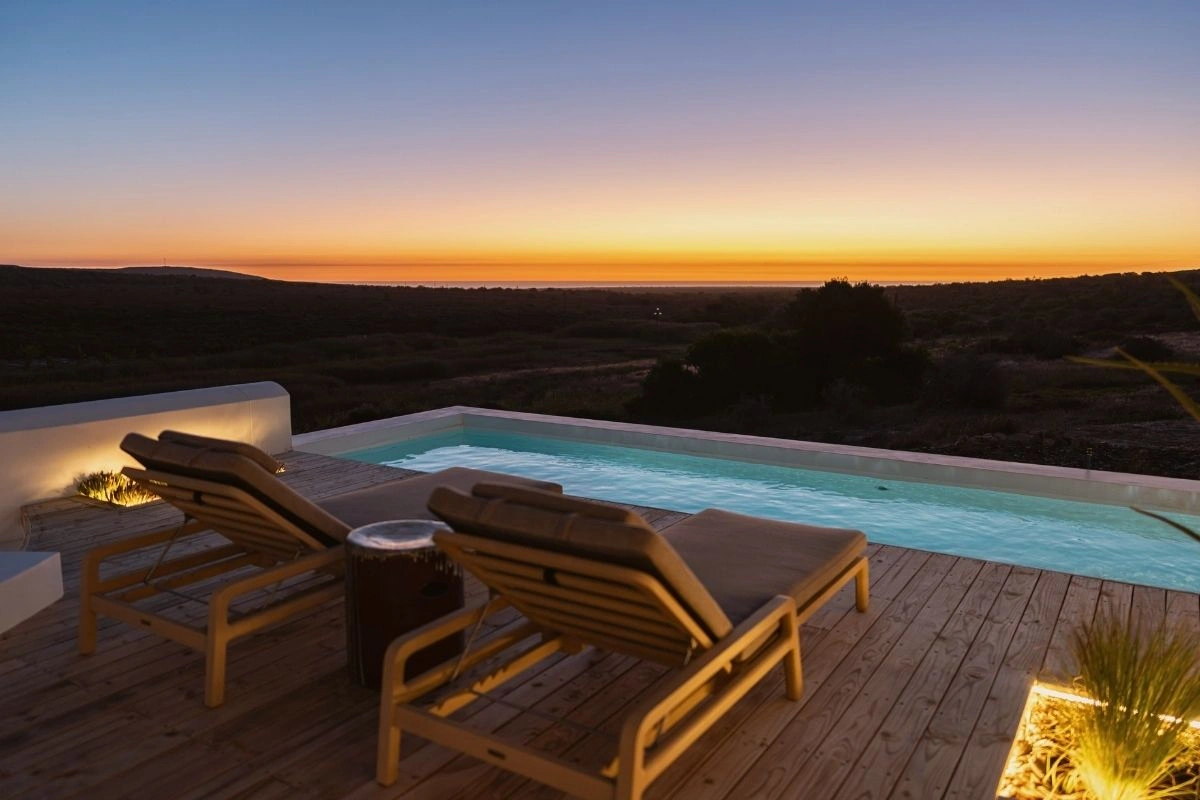
Facing the sea and gorgeous sunsets, and crisp night swims IMAGE Courtesy De Wildeveldt
Star-gazing from a wood-fired hot tub on the West Coast
We spent one of the most special evenings I can remember on the deck, with a bottle of wine, moving between the piping-hot tub and the brisk pool beside it. The pleasure was in the contrasts: hot and cold, but also sound and sight. The afternoon wind had dropped and everything was still. We heard an owl’s soft hoot. Nightjars began calling. Frogs struck up a chorus and, in the distance, the sea shushed softly.
We lay back in the hot tub and watched the Milky Way emerge. Stars bloomed, and satellites forged ahead regardless.
All weekend I’d lapped up luxuries on other people’s behalf, as a matter of professional duty. But of all the fine qualities at De Wildeveldt, the night’s lullabies and the dark sky were the finest. We slept better than we had in weeks.
DETAILS
Stay There are two different accommodation options available now, the villa we stayed and a thatch house. Two more farm buildings are being restored and will be good group options. Two-night booking minimum. Costs start at R9 000 for two guests, two nights.
Need to know De Wildeveldt is self-catering, although there will be some small local gifts in the kitchen. Do arrive with your shopping done — Yzerfontein and Darling are about 20 kilometres away, and you’ll want to relax when you arrive. It would be a pity to leave this super-calming environment. This place is ideal for couples or anniversary-style celebrations. Come to chill, take long walks or runs, bird and spend time with each other.
Activities There are a lot of options to pull you away from deep relaxation: hiking, birding, quad-biking, horse-riding with West Coast Horse Trails. Yzerfontein and Darling are both quite close by, both have enticements. The West Coast National Park is also close by.
Website www.dewildeveldt.com
TANDA TULA'S APPROACH TO LOW-IMPACT OPERATIONS
ENERGY A new system of 74 solar panels powers the borehole pumps and the guest operation, and lighting is energy-saving throughout. The owners estimate that solar covers around 80 per cent of demand. Because the system is so new, they are waiting for more data before confirming that figure. Energy use is not formally tracked or offset.
WATER All water comes from boreholes and is treated in an on-site desalination plant to bring it to drinking quality. The grounds and gardens are not watered at all: water is reserved for guests, and new planting is water-wise. Consumption is not yet metered, and guests are not yet asked to conserve. The owners acknowledge that both still need to be put in place.
WASTE Food waste is separated and composted on site, and recyclables are sorted and recycled. The remainder is removed from the farm. Bathroom products are refill-based, as are the olive oil and salt supplied to guests. Guest produce is packed in glass and recycled brown paper. Where plastic can’t be avoided, it is recycled.
CULTURE + COMMUNITY Every staff member comes from Darling, the nearest village. Many joined through the owners’ previous business connection to a wine farm and are being trained up to hospitality level. All staff are formally employed, with contracts and documentation, and are paid above the average wage. New positions, such as team leaders, are filled from within the existing team first. Staff do not hold equity in the business. The property also runs a farm school and aftercare programmes for the children who live on the land. The farm buys from local suppliers wherever it can, which keeps both the spending and the delivery distances close to home.
Conservation + Biodiversity De Wildeveldt covers 2 000 hectares within a conservation area, consolidated from former farms. It’s renosterveld and sandveld vegetation and a rewilding programme is under way, although the owner expects this to be a long process. The current focus is clearing alien Port Jackson; the cleared wood fuels guests’ hot tubs. Planting is indigenous only, and no pesticides, herbicides or other garden chemicals are used. Lights that aren’t needed are switched off at night and noise is kept down to protect wildlife.