

Scarlet-chested sunbird: this tiny creature changed a little girl's life forever and inspired a lifetime of art

In Southern Africa, two little girls fell in love with tiny details — one with a scarlet-chested sunbird, the other with intricate patterns and detail. Decades later, their shared delight has become a book
- Janine Stephen
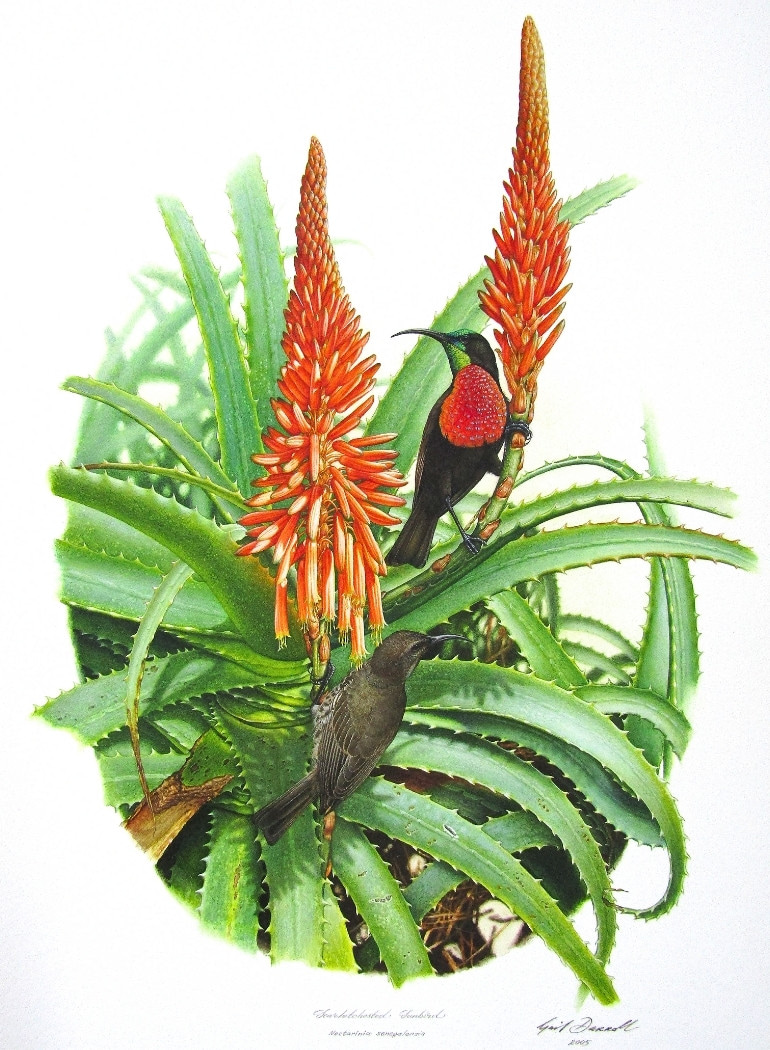
TOP AND ABOVE The delicate and detailed illustrations of a Scarlet-chested sunbird by artist Gail Darroll IMAGES Courtesy Jacana Media
It weighs just 13.6 grams, and it can fly, and its emerald throat is lovely beyond the singing of it.
In the 1950s a four-year-old named Ingrid roams a wild, unmanicured garden in what is now Harare, Zimbabwe. She is a bit ‘strange’, solitary, her head full of arcane knowledge about plants and insects gleaned from her field-naturalist father. She is too young to cycle, her mother doesn’t drive, there is no television and the white, warm days are a cocoon spun around them.
INTERVIEW This birder’s unique point of view is stretchning beyond her social media account
She is surrounded by books, attracted irresistibly to colour and pattern, and is already drawing copiously. She watches creatures, and captures them. She sits with her mother, examining the latest Vogue magazines posted from England — the ‘haughty faces’, imperious stances and apparel inspire her.
On the day she sees her first sunbird, she is wearing a red, madras-check blouse that is her favourite garment; it is soft from wear, yet the colour blazes. And she hauls herself into a gnarled, scarlet-leafed poinsettia because she is wearing that colour; she desires to be camouflaged, invisible. It is deliberate.
After a moment, a flying snippet of life alights beside her. It is velvet black and beady-eyed, and to her amazement, it has a vivid scarlet breast: a Scarlet-chested Sunbird (Chalcomitra senegalensis).
“I had red all around me,” Ingrid says 66 years later. “I froze, mesmerised. Within a moment it had shot away. I was dumbstruck; it was profound"
“For some reason it struck a huge chord, this first encounter with a wild bird, in that red tree, as I wore my red top.”
From that moment on, Ingrid was captivated by wild birds, not just the hens she’d cuddled up with (her first real friends). She went from filling scrapbooks with chickens decked out in 1950s Vogue stilettos, dangling earrings and fur stoles, to wild birds. From the word go “I knew I wanted to be an artist, and what my subject matter would be, and I was totally focused”.
REVIEW Sleep in Kogelberg Nature Reserve, one of the most biodiverse sanctuaries in South Africa
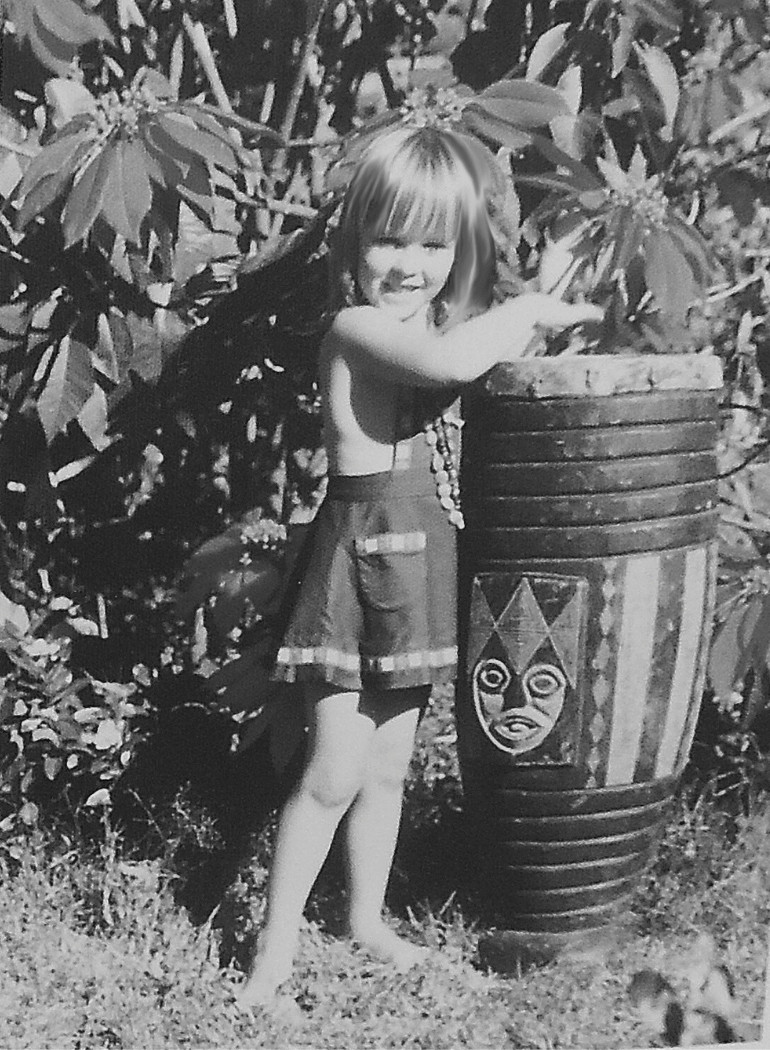
A young Ingrid Weiersbye in the garden IMAGE Courtesy Ingrid Weiersbye
Further south, again in the 1950s, another child was drawing obsessively in a Cape Town suburb. Her early exercise books were filled with intricate patterns; she was hard-wired to notice detail.
In her twenties, Gail Darroll eventually quit her day job, which involved drawing machines and equipment for a professor who demanded 100% accuracy. A series of her bird paintings had received murmurs of approval, and she’d decided this was the direction her life would follow. In 1981 she moved to Wilderness, where she has lived ever since, quietly, devoted to her work. For 17 years, much of that work was painting each of southern Africa’s sunbird species in extraordinary detail.
Gail used watercolour, that most unforgiving of mediums, capturing feathery and botanical detail with a tiny brush with barely a handful of bristles. For the Scarlet-chested Sunbird, she began with deep yellows and orange, gradually turning to tubes of cadmium, deep vermillion and scarlet to create its glowing red breast. It is, she says, her favourite sunbird. And yet, while she went on many field trips to see plants and sunbirds in their habitats, Gail had never seen a Scarlet-chested Sunbird alive; “I don’t live in an area where you get them.”
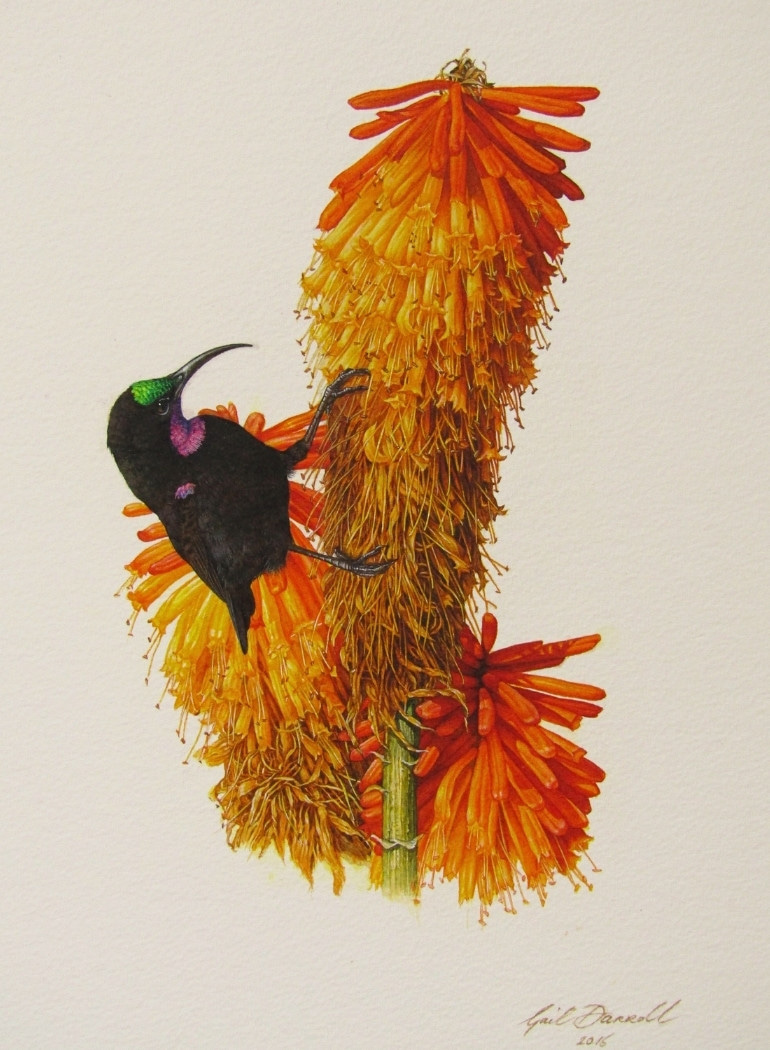
An Amethyst sunbird by Gail Darroll ILLUSTRATION Courtesy Jacana Media
Instead, her sunbird came flying to her side care of the Post Office (later, couriers filled the gaps). It was enclosed in a cardboard box, rolled in tissue paper, enfolded in cotton. It smelled rather strongly of naphthalene. It was a study skin, collected or found, a small tag attached to its toe, and it came courtesy of the Durban Natural Science Museum’s 40 000-skin collection.
Gail was always excited when a package arrived and she could study the feathers’ iridescence at leisure. From here, she would ‘design’ a bird with all the characteristics of the species, using photographs as additional source material on posture and behaviour.
This is where Gail and Ingrid’s stories intersect. The collection of illustrations Gail produced begged to be shared in a lush volume, and the John Voelcker Bird Book Fund—publisher of the Roberts Bird Guide—stepped in.
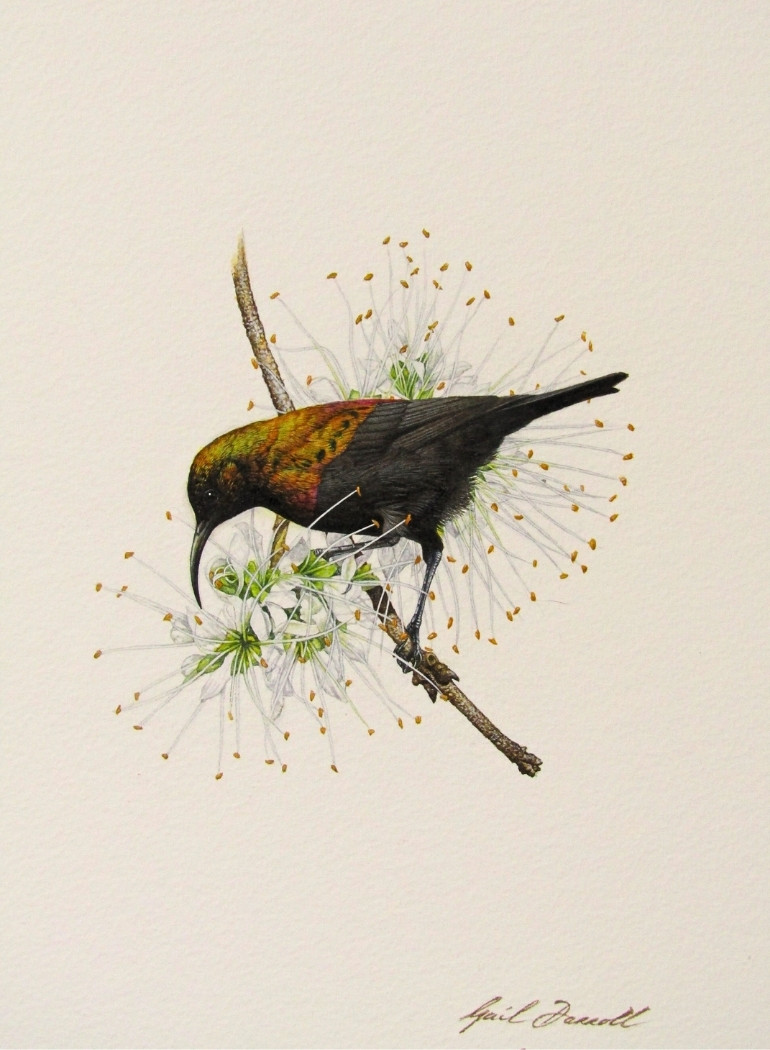
A Copper sunbird by Gail Darroll ILLUSTRATION Courtesy Jacana Media
Ingrid, a trustee of the fund, inherited the Sunbirds and Sugarbirds of Southern Africa project as creative editor and project manager. She’d already illustrated the sunbird family for the Robert’s guide and understood the challenge of capturing these jewels in paint.
The two artists finally met, and Ingrid was awestruck by Gail’s paintings. The discipline, the devotion, the time required! It almost made her wish she had stayed single, “unencumbered by mindless, onerous domesticity”.
Ingrid and Gail became good friends, agreeing on much, including their favourite sunbird. They delighted in fine observation of the bird: the blue spangles just visible within the scarlet on its chest, the spot of amethyst on a shoulder. It was an obvious cover star.
In paint, its tiny form, clinging to a Mountain Aloe, is finally still enough to stare at until sated. Such luxury.
SEE THEM …on Weeping Boer-bean trees (Schotia brachypetala) in the wider Kruger National Park area, in much of Zululand, including Hluhluwe,
around Victoria Falls, where rainbows meet iridescence, and
in savannah and riparian zones, as far north as Mali.
IUCN RED LIST CATEGORY Least Concern
SPARE THEM Don’t spray pesticides, which poison spiders and insects — and the sunbirds that rely on this source of protein.
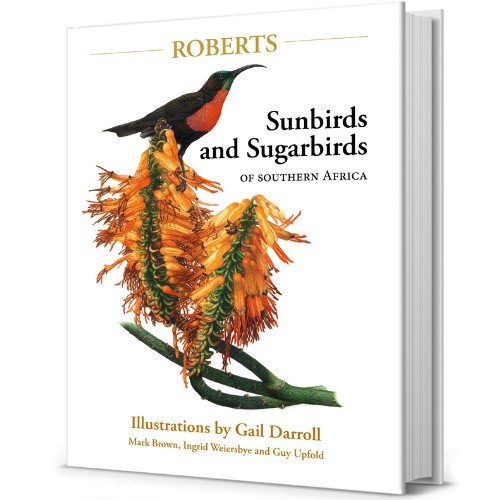
SUNBIRDS AND SUGARBIRDS OF SOUTHERN AFRICA
This exquisite coffee-table book is a treat. Illustrations are by Gail Darroll and the text by Mark Brown, Ingrid Weiersbye and Guy Upfold.
Buy Exclusive Books, Takealot, BookSite and Jacana Media
Cost R1 090